In this article
What to know
- The trials studied recombinant GH, not a compounded sermorelin program.
- The rehabilitation trial did not show improvement on several major functional or cognitive measures.
- Persistent post-injury symptoms need coordinated assessment rather than a hormone-only assumption.
Brain injury changes the assessment
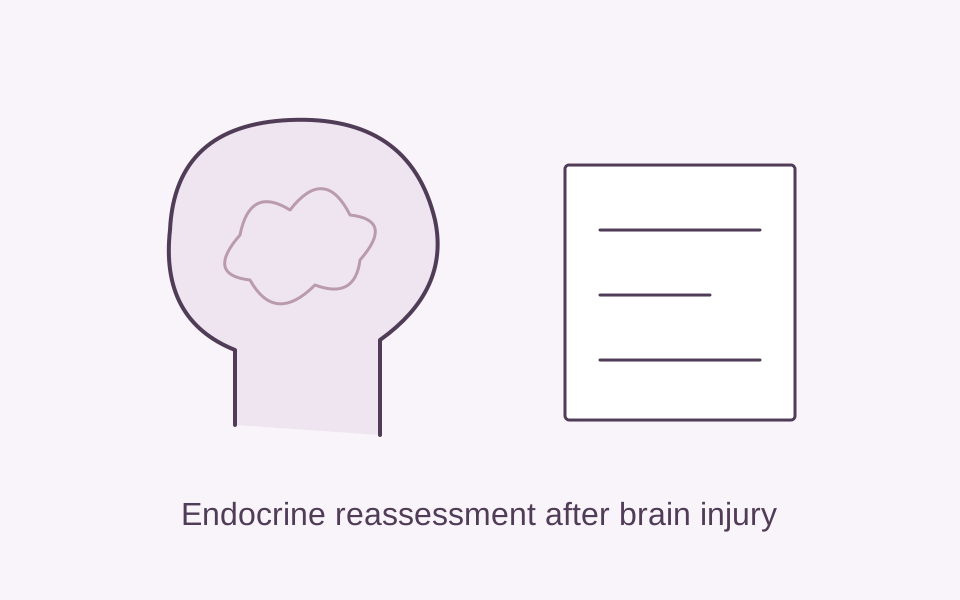
A traumatic brain injury can make a hormone assessment clinically relevant, but it does not make a marketed peptide the automatic next step. The studies discussed here tested recombinant growth hormone in specific rehabilitation or deficiency contexts, with mixed functional results. [1] [2] They did not test a retail compounded-sermorelin program. For a reader with fatigue, cognitive difficulties or reduced function after injury, the useful question is whether appropriate pituitary assessment is needed within coordinated care. Starting with the advertised treatment can skip the diagnostic work that determines what problem, if any, a hormone intervention should address.
The chronic-injury pilot was small
High and colleagues screened eighty-three people with chronic TBI, identifying forty-two with GH deficiency or insufficiency; twenty-three agreed to randomization to a year of GH replacement or placebo. The report described improvements on several motor and neuropsychological tests and no untoward treatment effects in that small group. [1] These were preliminary findings in a selected population, not evidence that every persistent post-concussion symptom responds to GH. The distinction between screened, eligible and randomized participants matters. It prevents the study from being described as an eighty-three-person treatment trial or as a general endorsement for an unselected wellness audience.
A rehabilitation trial gave a different answer
Dubiel and colleagues conducted a separate randomized, blinded feasibility trial beginning around discharge from inpatient rehabilitation, with six months of subcutaneous treatment and assessment at six and twelve months. The supervised protocol started at 400 micrograms daily, with IGF-1-guided adjustments of 100–200 micrograms at months one and three up to 1,000 micrograms daily; this describes the study, not personal instructions. Sixty-three participants were randomized and forty completed the trial. The GH group was not different from placebo on the Disability Rating Scale, Glasgow Outcome Scale-Extended or neuropsychological function, although some Functional Independence Measure change analyses favored GH. [2] This is a more complicated result than either treatment works or treatment never works. It supports continued investigation while leaving the main clinical outcome uncertain in the studied rehabilitation setting.
For the broader context, read GH stimulation testing and diagnosis.
Hormone response did not guarantee functional improvement
IGF-1 increased during GH treatment in the rehabilitation trial, but a higher hormone-related measure did not establish better neuropsychological function. The report also notes that the favorable FIM change analyses were not corrected for multiple comparisons. [2] That matters when many outcomes are assessed: a nominally positive result should not automatically dominate the overall conclusion. A consumer summary should retain the null outcomes and the statistical boundary. Otherwise, a biological response can be made to sound like proof of restored cognition or independence even when the trial did not demonstrate that broader result.
Safety findings need their actual context
The rehabilitation study described overall tolerability, but two seizures occurred in the GH group and none with placebo; the small between-group difference was not statistically significant. [2] That observation neither proves causation nor supports saying there were no adverse events. A small feasibility study cannot provide a precise long-term safety estimate. The appropriate clinician must consider the person’s injury history, other conditions and medicines. A reader should not infer that stimulating natural signaling is inherently safer, or that a commercial secretagogue can be substituted for the studied intervention without changing the risk and evidence questions.
Screening is broader than GH alone
The British Neurotrauma Group’s guidance addresses pituitary dysfunction after TBI as a broader assessment problem, including who should be screened, when and how to coordinate care. [3] It is not a protocol for purchasing a wellness peptide. The endocrine consequences of injury can involve more than GH, so a narrow focus on an attractive treatment may overlook the reason a clinician needs the full history. Obtain the hospital and rehabilitation records and clarify which team is responsible for follow-up. A useful pathway links the symptom, injury context and appropriate tests rather than treating a broad fatigue complaint as a sufficient diagnosis.
A low IGF-1 is not the complete work-up
A single IGF-1 value should not become the sole gatekeeper for a complex post-injury assessment. In the rehabilitation study, baseline IGF-1 did not correlate with the available stimulated GH measurements. [2] That does not mean the blood test has no role; it illustrates why a clinician may need more information. Testing choice and timing depend on the clinical situation and the relevant guidance. A self-purchased result can provide data without settling the diagnosis. The patient needs interpretation within the injury and recovery history, rather than an online threshold presented as automatic eligibility for treatment.
Why GH replacement is not sermorelin evidence
Recombinant GH replacement and sermorelin are different interventions. One supplies hormone; the other is a releasing-hormone analogue intended to stimulate a response. Evidence involving one cannot simply be transferred to the other, especially when injury may affect different parts of the endocrine pathway. The TBI trials reviewed here therefore do not establish that a compounded sermorelin subscription improves post-concussion cognition. [1] [2] A provider discussing such a prescription should explain the actual rationale and acknowledge the gap instead of using the general phrase growth-hormone support to merge distinct products and patient populations.
Keep the distinction clear with sermorelin cognition and memory evidence.
The next useful clinical step
The practical next step is a coordinated medical conversation about persistent symptoms and whether appropriate pituitary evaluation is indicated. Bring the injury date, severity, hospital course, current medicines, rehabilitation history and prior laboratory results. Do not stop established rehabilitation or other prescribed care to follow a peptide-marketing timeline. If treatment is considered after assessment, compare services on the actual preparation, monitoring and complete commitment. The strongest conclusion from these studies is that this is a legitimate clinical research question with mixed results, not a demonstrated retail solution for every person who feels different after a head injury.
For a separate practical comparison, see Defy Medical review; a product review does not turn this study into a treatment recommendation.
Sources
Research describes groups and specific study conditions. Your medical history, symptoms and treatment decisions require advice from your own qualified clinician.