In this article
What to know
- Diagnostic hormone challenges do not establish ongoing treatment benefit.
- BMI and clinical context affect cutoff interpretation.
- Ask for separate support for diagnosis and the selected prescription.
A hormone challenge asks a diagnostic question
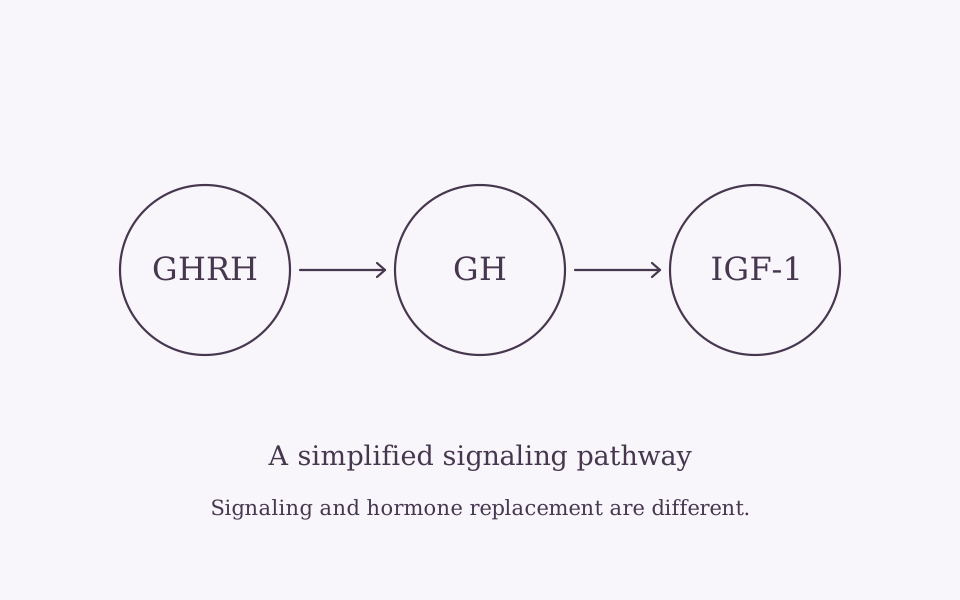
A GHRH-arginine test investigates growth-hormone response under controlled conditions. It is not a trial showing that ongoing sermorelin improves sleep, strength or healthy aging. That difference can disappear when a treatment page cites a diagnostic paper as if it established a consumer benefit. The study may be sound while the sales inference is not.
The useful reading starts by asking what decision the researchers were trying to improve. Diagnostic classification, physiological responsiveness and treatment effectiveness require different comparisons. A person producing a hormone after stimulation has supplied one kind of information. Whether prescribing a repeated intervention improves that person's health is another question, with a different burden of evidence.
BMI changed the diagnostic boundary
Corneli and colleagues studied GHRH-arginine responses in 322 patients with hypothalamic-pituitary disease and 318 controls. They evaluated BMI-specific cutoffs because thresholds derived in lean people did not transfer reliably to people with obesity. [1] This is directly relevant to interpretation: a response cannot be labeled low without considering how the reference was developed.
It is not a reason to copy thresholds from a paper into an online self-assessment. The population, assay, protocol and clinical context matter. A number can be accurately measured yet misclassified when the wrong decision rule is applied. That is the problem diagnostic research is trying to address, rather than a claim that a particular commercial service should prescribe treatment.
Newer work revisited the tradeoff
A 2023 study examined responses in 358 patients with a history of hypothalamic-pituitary disease and reconsidered BMI-specific thresholds using a clinical definition of deficiency. [2] Its sensitivity and specificity analyses illustrate a familiar diagnostic tradeoff: changing a cutoff can reduce one kind of error while increasing another.
A consumer does not need to memorize the thresholds to understand the implication. The same observed value can have a different meaning under a different reference method or prior clinical likelihood. Ask the clinician why the test is appropriate and how the result changes the next step. A test result should fit a clinical explanation, rather than merely provide a number that makes an existing sales plan appear justified.
To understand the related evidence, read Igf 1 results context.
For the evidence behind a specific diagnostic option, read Macimorelin testing: diagnosing GH deficiency is not hormone optimization.
Childhood diagnosis may need re-evaluation
Aimaretti and colleagues studied young adults previously treated for childhood-onset GH deficiency, comparing different underlying diagnostic groups and retesting responses. [3] That is a transition-of-care question. It is not a study of otherwise healthy middle-aged adults seeking better recovery after exercise.
The distinction is useful when a reference list includes impressive diagnostic terminology. A paper can be directly relevant to one patient group and only distantly related to another. Its inclusion should not allow a service to imply a broader benefit than the research measured. The clinician's task is to connect the individual history to the appropriate assessment, not to treat every low-energy complaint as equivalent to documented pituitary disease.
A low result is not a complete diagnosis
The diagnostic papers demonstrate why thresholds need context. They do not establish that an isolated consumer laboratory result should determine treatment. [1] [2] [3] Before accepting a plan built around a number, ask what prompted testing, which method was used and whether other clinical findings support the interpretation.
This does not mean every abnormal result is unimportant. It means the significance depends on the actual question. A laboratory value can support further investigation, a specific diagnosis or no change at all, depending on the setting. A useful service explains that decision plainly. It should not require a buyer to infer a diagnosis from a colored range or assume that moving a number upward is automatically beneficial.
The treatment claim needs a separate experiment
Even a well-supported diagnosis does not establish the effectiveness of every proposed treatment format. A repeated injection, an oral dissolving product and a multi-ingredient blend need evidence appropriate to the actual intervention. A diagnostic challenge cannot determine their equivalence because it was designed to measure something else.
For a buying decision, ask the provider to distinguish the evidence supporting the diagnosis from the evidence supporting the proposed treatment. Then ask how the outcome will be assessed and how treatment will be reconsidered if it does not help. These are separate clinical commitments. A clear answer is more useful than a reference list that mixes stimulation tests and outcome trials without explaining their different roles.
For the practical product comparison, see Compare two injection services.
A practical consultation agenda
Bring the test report, relevant history and the specific question you want answered. Ask what the result establishes, what remains uncertain and whether it changes the care plan. If a service recommends sermorelin, request the exact preparation, route, clinical purpose and review plan alongside the full financial terms.
The diagnostic literature is valuable precisely because it is specific. Its selected populations and classification methods should remain visible when it is cited. The appropriate conclusion is that GH testing requires context, not that an online shopper can diagnose deficiency or select a peptide from a peak response. A strong service agreement follows a clear clinical explanation; it should not replace one.
Sources
Research describes groups and specific study conditions. Your medical history, symptoms and treatment decisions require advice from your own qualified clinician.