In this article
What to know
- Small HIV studies found thymic and immune-marker changes with recombinant GH. They did not test sermorelin or general resistance to infection.
- The study population, intervention and chosen outcome set the limits of the finding.
- A biological signal does not establish a broad wellness benefit.
An intriguing result with a narrow address
The idea that a hormone might restore immune function is compelling. It becomes more useful when the actual participants and measurements are named. In small studies of adults living with HIV, researchers examined recombinant growth hormone alongside antiretroviral treatment and reported changes in thymic imaging and selected immune markers. This was a specialist research setting, not a trial of sermorelin for healthy aging. [1] [2]
The distinction is central to reading an immune-support claim. A finding can be biologically interesting without establishing that a wellness customer will experience fewer infections, recover faster, or live longer. Those are different questions. The HIV studies deserve their own account because their strength lies in investigating a specific problem under defined conditions. Removing that clinical setting makes the findings easier to advertise and harder to interpret correctly.
What the first randomized study examined
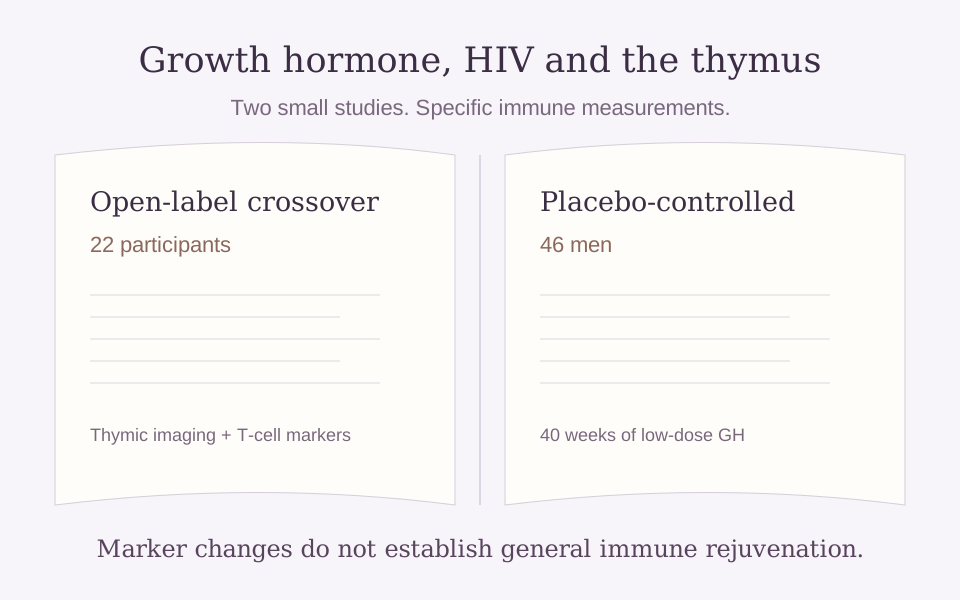
Napolitano and colleagues enrolled 22 participants in a two-year randomized, open-label crossover study. They assessed thymic density, T-cell receptor rearrangement excision circles and circulating immune-cell populations. Recombinant GH was associated with thymic and immune-marker changes. [1] The study therefore offers evidence about biological activity in the enrolled HIV population.
Open-label means treatment assignment was known. Randomization and laboratory measurements remain valuable, but the design should not be described as a large blinded clinical-outcomes trial. The small cohort also limits how confidently its results can represent patients with different histories or people without HIV. A useful summary keeps those design features close to the reported response. Otherwise the reader may mistake an exploratory physiological experiment for a mature treatment comparison.
Read our adult sermorelin evidence review for the next part of the decision.
A second trial strengthens one part of the picture
A Danish double-blind placebo-controlled trial included 46 men with HIV receiving antiretroviral therapy. It tested low-dose recombinant GH for 40 weeks. Thymic density and selected TREC measurements improved relative to placebo, while differences in total and naive CD4-cell changes were not statistically significant. [2]
This combination of findings matters more than a single favorable percentage. A response in one immune measurement does not mean every related marker improved convincingly. The placebo control makes the comparison more informative, while the selected male cohort still defines its reach. The later study provides additional support for a thymic signal; it does not establish a general immunity benefit across adults, products or clinical settings. Reporting the neutral cell-count comparisons alongside the imaging result preserves that balance.
What thymic imaging and TRECs can tell us
In these papers, thymic imaging and TRECs were tools for examining thymic activity and immune reconstitution. [1] [2] Think of them as different views of a biological question. They should not be translated into a simple immune-age score, especially when a commercial description supplies no validated connection between the score and an outcome that matters to the patient.
For an everyday benefit claim, ask what happened to infections, hospitalization or another prespecified clinical endpoint. An imaging change cannot answer that question merely because it appears favorable. Nor is a cell population a universal measure of how well a person resists every pathogen. The appropriate conclusion should name the observed measurement, its comparison group and the uncertainty around it. More ambitious language requires a study that actually measures the more ambitious outcome.
A later substudy examined stored samples from the Danish trial using HIV-specific laboratory response assays. It included 21 GH recipients and 15 placebo recipients with paired samples. [4] This adds another biological view of the original experiment, rather than an independent trial showing fewer infections. Counting publications without checking shared participants can make the evidence base appear larger than it is.
Safety belongs beside the mechanism
The 2008 study reported frequent adverse events, including joint symptoms, edema and glucose-metabolism abnormalities. [1] These findings deserve attention alongside the thymic response. They cannot be converted into a risk percentage for every GH regimen or transferred directly to sermorelin. The preparation, exposure and patient population remain relevant.
An account that lists only laboratory gains leaves the reader without the other half of a treatment decision. Ask whether symptoms required dose changes, whether participants stopped treatment, and how the potential benefit was weighed against the burden. The smaller low-dose trial described treatment as well tolerated, but that does not erase the adverse-event findings in a different regimen. [2] A difference between studies invites a careful comparison of their conditions rather than a choice of whichever safety sentence feels most reassuring.
Read our adverse-event and monitoring guide for the next part of the decision.
Why sermorelin is still a separate question
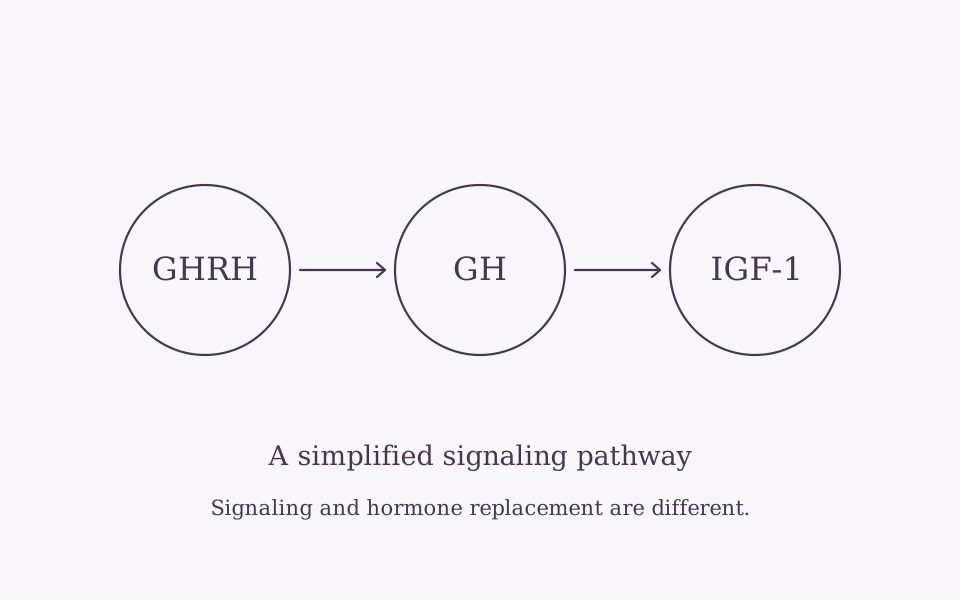
Neither trial administered sermorelin. [1] [2] Sharing part of a hormone pathway does not make preparations interchangeable. A service offering a GH-stimulating peptide would need evidence for its own preparation and clinical purpose before citing these studies as proof that its customers receive the same immune effect.
This is also separate from treatment of diagnosed adult GH deficiency. The Endocrine Society guideline describes a diagnostic and individualized treatment context, usually requiring stimulation testing for confirmation. [3] A thymic study in HIV does not create a new eligibility rule for a person with fatigue or an age-related change in IGF-1. Those problems require their own assessment. An immune-benefit pitch should not stand in for an explanation of why a particular patient needs a particular medicine.
Read our GH diagnostic-testing guide for the next part of the decision.
Questions worth bringing to a consultation
When a program invokes immune rejuvenation, ask for the exact human trial supporting the claim. Then identify whether it used recombinant GH or a secretagogue, whether participants had HIV or another defined condition, and whether the study measured clinical illness or markers. This short exercise often reveals the missing steps between a published paper and a consumer promise.
The point is to make a treatment conversation more concrete. A clinician should be able to explain the proposed purpose, relevant uncertainties, monitoring and alternatives in ordinary language. If the supporting evidence consists of studies in a different population using a different medicine, that limitation belongs in the decision. It should not be hidden behind an impressive description of the pathway or a claim that the body is merely being encouraged to act naturally.
The conclusion the evidence can carry
These HIV studies offer a reason to investigate the connection between GH and thymic function. They support a narrower statement about selected imaging and immune-marker responses, with important design and safety limitations. [1] [2] They do not demonstrate that sermorelin improves general resistance to infection or reverses immune aging in otherwise healthy adults.
For a reader comparing commercial care, that leaves a practical boundary. Evaluate the actual prescription and reason for treatment first. Keep any immune claim attached to the population and outcome that produced it. Interesting specialist research can inform a thoughtful discussion without becoming a general wellness indication. The most credible interpretation preserves both its scientific interest and the considerable distance between those findings and a promise about how a customer will feel or function.
Sources
- Napolitano et al. (2008): GH and thymic function in HIV (opens in a new tab)
- Hansen et al. (2009): placebo-controlled low-dose GH thymic study (opens in a new tab)
- Endocrine Society: adult GH deficiency guideline (opens in a new tab)
- Herasimtschuk et al. (2013): HIV-specific T-cell response substudy (opens in a new tab)
Research describes groups and specific study conditions. Your medical history, symptoms and treatment decisions require advice from your own qualified clinician.