What to know
- A study lasting six weeks or six months does not identify when every participant first benefited.
- Historical sermorelin and trials of other GHRH analogues must be distinguished.
- Agree on the clinical purpose, assessment and financial commitment before treating a timeline as a promise.
There is no reliable universal countdown
Published adult research does not provide one dependable week-by-week schedule for when a person will feel better on a current sermorelin service. A hormone change, an outcome measured at the end of a study and a noticeable improvement are different events. A promise that moves from one to another without explanation is stronger than the evidence it cites.
That does not mean adult research is absent. It means the answer needs a named product and a specific goal. A claim about sleep should be supported by sleep outcomes; a claim about physical function should show function. A laboratory response cannot supply the missing calendar for either.
What six weeks meant in one older study
Vittone and colleagues studied nightly subcutaneous GHRH 1–29 in 11 healthy older men over six weeks. The study reported increased nocturnal growth-hormone release, no change in IGF-I and improvement on selected strength or endurance measures. This was a small physiological experiment, not a weekly estimate of symptom improvement across the people considering treatment today. [1]
Its six-week duration should therefore remain an assessment interval. It does not establish that a benefit begins on day 42, that everyone notices one earlier, or that the result applies equally to another route or preparation.
The six-month cognitive study answers another question
Vitiello and colleagues randomized 100 healthy older adults in a six-month placebo-controlled study; 89 completed it. The methods identify the preparation as subcutaneous sermorelin acetate, GEREF. Cognitive testing was performed at baseline and at six months, with favorable findings on selected tasks. [2]
A before-and-after assessment at six months cannot locate the first week of a meaningful cognitive change. Nor does a result on selected tests establish prevention of dementia or preservation of independence. A modern service should not convert this study design into a guaranteed six-month personal result.
Check whether the frequently cited paper used sermorelin
Baker and colleagues’ 20-week controlled cognitive trial used tesamorelin, a stabilized GHRH analogue, rather than sermorelin. It enrolled older adults with and without mild cognitive impairment. Its reported cognitive findings belong to that intervention and study population. [3]
Grouping both products under GHRH does not make their timelines interchangeable. The distinction is especially important when a commercial explanation borrows a study duration, removes the analogue’s name and presents the result as a schedule for a different prescription.
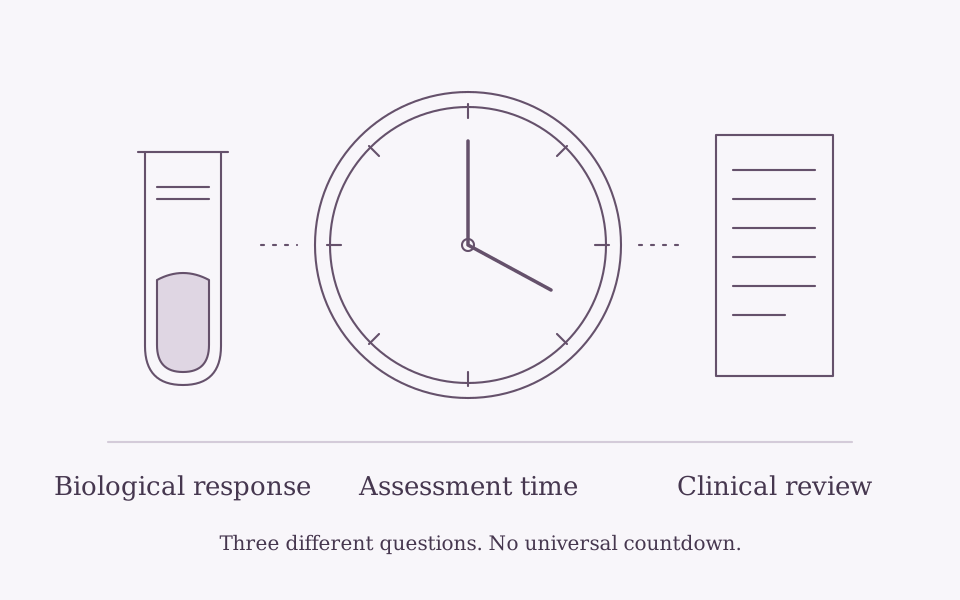
Three clocks to keep separate
An assessment can be sensible without proving a promised benefit. The useful distinction is what the clinician is checking and what the result would change.
| The clock | What it describes | What it does not establish |
|---|---|---|
| Hormone measurement | A biological response at a collection time | Relief of every symptom |
| Study endpoint | An outcome measured at a scheduled visit | The first day a participant benefited |
| Personal clinical review | Whether a proposed plan remains appropriate | A guaranteed result by a fixed week |
A timeline needs a review decision
A useful treatment discussion identifies the actual concern, how it will be assessed and when the clinician will reconsider the plan. Ask what would count as worthwhile progress and what would lead to reassessment. These are questions for a qualified clinician who knows your history; the answers are not supplied by buying a standard course in advance.
For example, a scheduled laboratory visit may be intended to monitor a response rather than certify better sleep. If the stated goal is sleep, ask how sleep itself will be evaluated. The monitoring visit and the benefit claim should have distinct explanations, even when they occur in the same month.
Do not let the billing calendar become the clinical explanation
A three-month package, a renewal date and a clinical review interval can coincide without being the same decision. Before committing, establish the amount collected now, the services included, the testing charges and the cancellation terms. Ask whether follow-up continues if the plan changes and whether unused prepaid supply is refundable.
A longer prepaid term does not strengthen a study’s relevance. Equally, a modest early observation is not a reason to declare an intervention successful without an agreed assessment. The strongest explanation connects a defined clinical purpose to a review decision, then states the financial commitment separately. That is more useful than an attractive sequence of weeks with a different benefit assigned to each.
Sources
Research describes groups and specific study conditions. Your medical history, symptoms and treatment decisions require advice from your own qualified clinician.