In this article
What to know
- Small GHRH experiments changed hormone profiles in older adults. Restoring a laboratory pattern does not establish longer life, better function or the best retail treatment schedule.
- The studied preparation and population define what the findings can support.
- Research regimens describe experiments and are not personal treatment instructions.
A pulse pattern is a physiological finding
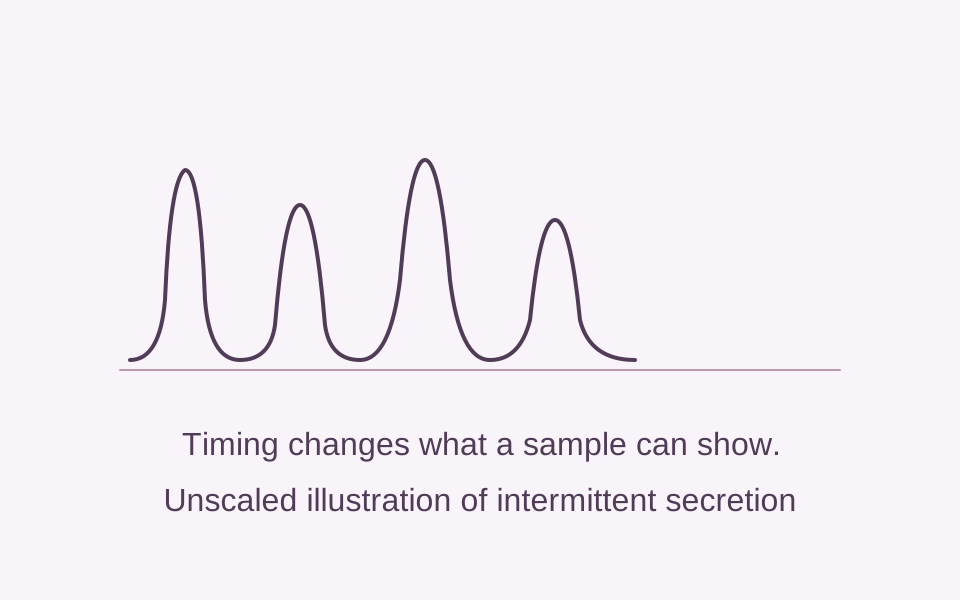
Growth hormone is released in a changing pattern rather than as one fixed concentration, and small GHRH studies investigated how that pattern responds in older adults. [1] [2] [3] This physiology explains why a random blood result and a carefully sampled profile answer different questions. It does not establish that recreating a younger-looking pattern necessarily improves health or extends life. A releasing signal can produce a measurable endocrine response while the clinical value remains uncertain. The useful interpretation separates the signal, the measured downstream result and the outcome the person actually wants. A service description should preserve those steps rather than make the mechanism stand in for a treatment trial.
Sampling density matters to the interpretation. A few isolated blood draws cannot reproduce the information in a profile assembled across a day or night. A product claim about normalizing pulses therefore needs evidence that actually examined the pattern, rather than a single downstream marker. Even an accurately measured profile still requires a separate link to meaningful benefit before it can justify a broad rejuvenation claim.
The twice-daily experiment was brief
Corpas and colleagues sampled nine young and ten older nonobese men, then tested subcutaneous GHRH 1–29 in the older men at 0.5 mg and 1 mg twice daily for fourteen days each, with fourteen days without treatment between periods. Only the higher regimen significantly increased GH and IGF-1 in the reported comparison. [1] These are research procedures, not instructions to copy. The experiment demonstrated an endocrine response under selected conditions; it did not establish years of improved function, reduced disease or longer survival. Healthy nonobese older men are also not interchangeable with people who have obesity, pituitary disease or several concurrent treatments.
Nightly dosing asked a different question
Vittone and colleagues gave eleven healthy nonobese men aged sixty-four to seventy-six, selected for low baseline IGF-1, subcutaneous GHRH 1–29 at 2 mg nightly for six weeks. Mean GH and peak amplitude increased, but pulse frequency and IGF-1 did not. Two of six strength tests and abdominal endurance improved; body composition, glucose and lipid measurements did not. No significant adverse effects were reported over the short interval. [2] These are research findings, not a recommended routine. The uncontrolled small study differs from the twice-daily experiment. It cannot establish an optimal retail schedule or show that a greater GH pulse necessarily produces the full downstream or clinical response a buyer expects.
For the broader interpretation, read IGF-1 measurement and interpretation.
The modified analogue needs its full name
Khorram and colleagues studied nineteen older adults, nine men and ten women aged fifty-five to seventy-one, using four weeks of nightly saline followed by sixteen weeks of subcutaneous [Nle27]GHRH 1–29 amide at 10 micrograms/kg nightly. This modified analogue is not simply ordinary sermorelin, and the regimen describes research rather than treatment advice. Nocturnal integrated GH increased; IGF-1 rose early but returned toward baseline by week sixteen. Sleep quality did not improve, lean mass increased in men only and transient hyperlipidemia resolved by study end. [3] The peptide identity and time course prevent treating the experiment as a universal claim that nightly sermorelin restores all youthful hormone patterns or improves sleep.
Hormone restoration is not restored youth
The word restoration can describe bringing a measured hormone pattern closer to a comparison group. It does not, by itself, establish restored health, reversed aging or a longer lifespan. The early studies here investigated endocrine and selected metabolic or functional observations over limited periods. [1] [2] [3] A broad rejuvenation claim would require different evidence, including meaningful outcomes and adequate follow-up. This distinction also applies to IGF-1. A change can demonstrate biological action without establishing that the original fatigue or poor recovery was caused by an insufficient value. The physiological result is useful information, while the clinical interpretation still depends on the individual situation and actual outcome.
A research schedule is not a prescription template
Timing and frequency in a paper describe the experiment. They are not instructions to increase injections, copy another patient’s routine or select a regimen from the largest reported hormone change. The studies used different schedules and preparations. [1] [2] [3] A person’s actual prescription, pharmacy instructions and clinical assessment should govern treatment. Ask why the proposed schedule fits the intended purpose, how response is assessed and what happens if benefit is absent or an unwanted effect appears. The answer should include more than a statement that dosing mimics nature. An appealing physiological analogy does not establish the safest or most effective plan for every person.
What the physiology means when choosing a service
For a service comparison, the early GHRH studies support a specific conclusion: older adults can show endocrine responses to particular releasing-hormone interventions under research conditions. They leave major questions about clinical benefit, long-term use and retail-product equivalence unresolved. Compare the exact preparation, evaluation, monitoring and complete financial commitment after those limits are clear. A provider can make a credible case for a consultation by explaining the uncertainty and individual purpose. It should not need to promise that a pulse pattern recreates youth. The most useful plan distinguishes what can be measured from what would make the treatment worthwhile in ordinary life, and identifies when that decision should be revisited.
For a practical product comparison, see our AlphaMD review; its purchase terms do not establish a clinical result.
Sources
Research describes groups and specific study conditions. Your medical history, symptoms and treatment decisions require advice from your own qualified clinician.